How Illinois State Tax Refunds Can Impact Your Personal Loan Eligibility
KM
Katy McWhirter
Finance & Loans Editor · Updated September 2026

Katy McWhirter
Finance & Loans Editor · Updated September 2026
Imagine it is late April 2026 in Springfield. You have just received notification that your Illinois state tax refund, a much-anticipated lump sum of $3,500, has been deposited into your checking account. For many residents, this feels like an unexpected windfall—a financial cushion that could make the prospect of taking out a personal loan feel significantly less daunting. However, if you are planning to apply for credit shortly after that deposit hits, there is a critical distinction between having more money in your bank account and actually being more eligible for a loan.
A common misconception among Illinois borrowers is that a large tax refund automatically increases their 'income' in the eyes of a lender. In reality, most lenders view a state tax refund as a one-time event rather than recurring monthly income. While having that cash can certainly improve your liquidity, it does not necessarily change the fundamental math used to determine your creditworthiness. This article will help you navigate how this windfall might indirectly influence your ability to secure financing and what steps you should take to leverage it effectively.
In 2026, the lending landscape remains highly data-driven. Lenders typically look at several key metrics, including your Debt-to-Income (DTI) ratio, your credit score, and your overall liquid assets. For example, a borrower with an average APR of 12% on a $10,000 loan over 36 months might find that their monthly payment is approximately $332. While the refund won't change their base salary, it could be used to pay down existing debt, which changes everything. We will explore how to use this timing and these funds to your advantage without falling into common financial traps.
The most significant way an Illinois state tax refund can influence your loan application is through its impact on your Debt-to-Income (DTI) ratio. Lenders use DTI to determine if you have enough 'breathing room' in your monthly budget to take on a new payment. If you apply for a loan with high existing debt, even a large tax refund might not help you qualify unless that money is used strategically.
Consider this scenario: A borrower has two credit cards with combined minimum payments of $500 per month. Their gross monthly income is $4,000. This results in a DTI of 12.5% just for those two cards. If they receive a $3,000 Illinois tax refund and use it to pay off one card entirely, their monthly obligations might drop by $200. Suddenly, that borrower is in a much stronger position to qualify for a new personal loan because their monthly debt burden has decreased.
The nuance here is that lenders are looking for stability. A $5,000 refund in 2026 is a great tool for debt reduction, but it won't act as a substitute for a steady paycheck during the underwriting process. If you want to use your refund to boost your eligibility, focus on paying down balances rather than just letting the cash sit idle.
When you sit down with a lender, they are essentially performing a math problem. They want to know: 'Can this person afford $400 more every month?' A common mistake is thinking that if you receive a $5,000 refund, your annual income has effectively increased by $5,000 for the purpose of loan qualification. In most cases, this is incorrect. Lenders typically look at your W-2 or 1099 forms to verify your base earnings.
To understand the real impact, we must distinguish between 'liquidity' and 'income.' Liquidity refers to how much cash you have available right now; income refers to the flow of money over time. A high liquidity position (having a large refund in your account) might make a lender feel more confident about your ability to handle an emergency, but it does not change the mathematical calculation of your monthly income versus your monthly debt.
For example, compare these two strategies:
Option A: Using a $4,000 refund to build a savings buffer. This increases your liquidity and provides peace of mind, but your DTI remains unchanged.
Option B: Using the same $4,000 refund to pay off a personal loan that has a $250 monthly payment. This directly lowers your DTI and could lead to higher loan amounts or better rates on future applications.
While Option A is excellent for long-term stability, Option B is the superior strategy if your immediate goal is increasing your borrowing power in 2026. Understanding this distinction is vital before you submit an application with a lender.
In the world of personal finance, timing can be just as important as your credit score. In 2026, many Illinoisans find themselves in a unique position during the months of March and April due to the tax filing cycle. If you are planning to apply for a loan, there is a strategic 'window' that occurs immediately after your state refund hits your account.
Applying right after receiving a significant deposit can provide a clear 'paper trail' in your bank statements. When an underwriter reviews your last three months of activity, seeing a large, legitimate deposit from the Illinois Department of Revenue can demonstrate financial stability and sudden liquidity. This is particularly helpful if you are applying for a loan to consolidate debt or make a major purchase like home improvements.
However, there is a catch. If you apply for a loan before your refund arrives, you might be rejected based on current debt levels. If you wait too long after the refund is spent, that 'extra' liquidity vanishes from your statements. Therefore, the optimal strategy often involves:
1. Confirming the exact date of your expected deposit.
2. Using a portion of the funds to clear small, nagging debts.
3. Applying for the loan within 30-60 days of the deposit appearing on your statement.
By coordinating these steps, you present yourself as a borrower who is not only stable but also actively managing their finances. This proactive approach can make a significant difference in how a lender perceives your risk profile.
How you receive your Illinois state refund might matter more than you think. In 2026, digital-first banking is the standard, and lenders have become increasingly accustomed to verifying income through electronic bank statements. The method of delivery for your tax funds can influence how easily a lender can verify your financial standing.
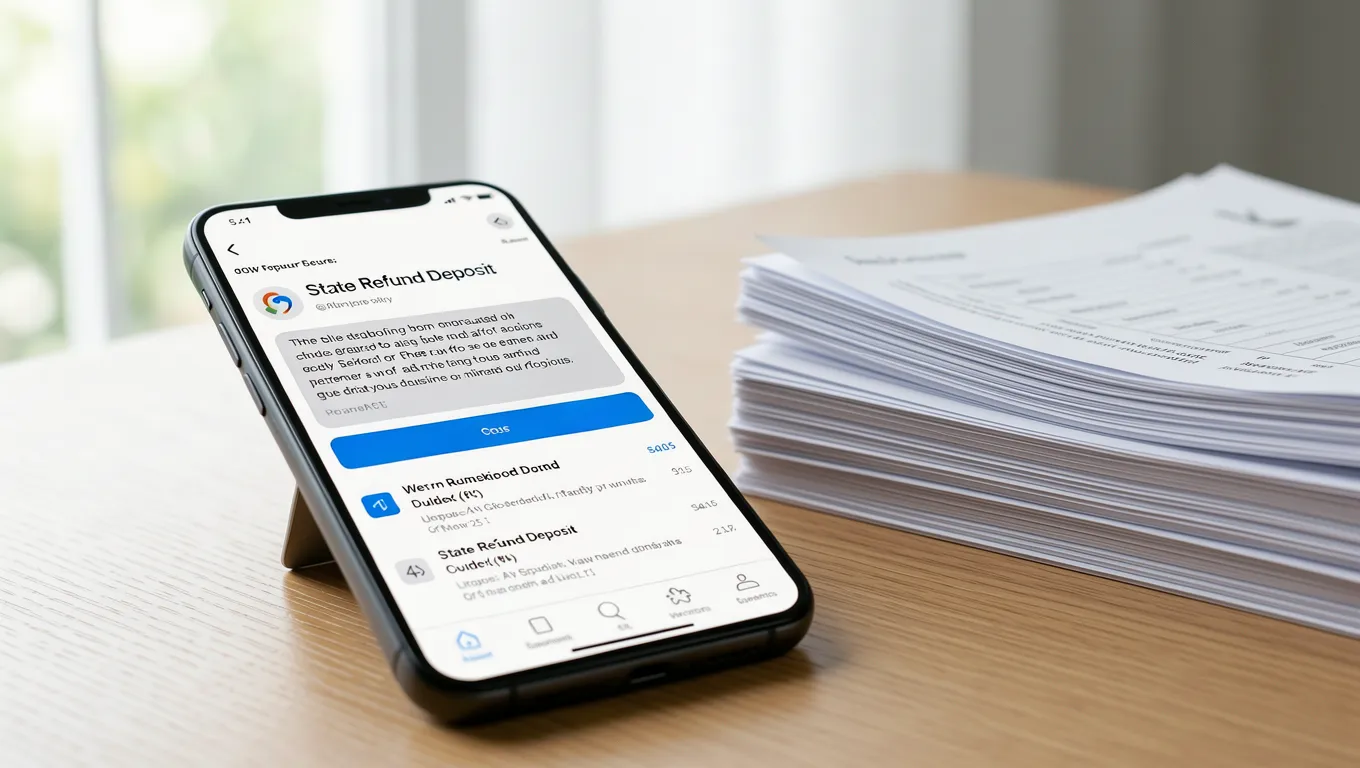
When a refund is sent via direct deposit, it appears clearly on your transaction history with a specific, recognizable label from the state. This makes it incredibly easy for an underwriter to see that this was a legitimate one-time influx of cash. On the other hand, if you still receive paper checks and manually deposit them at a local bank branch or ATM, there can be a slight delay in how those funds are reflected on your official electronic statements.
If you are planning a loan application in 2026, we recommend ensuring your banking information with the Illinois Department of Revenue is up to date. The smoother and faster the money moves into your account, the easier it is for you to show that liquidity during the underwriting process. A 'clean' digital trail is always preferable when trying to demonstrate a sudden improvement in your financial position.
One of the most dangerous mistakes borrowers make is treating their tax refund as a 'guaranteed' source of repayment for a new loan. This is a psychological trap that can lead to significant financial distress. Because refunds are unpredictable and vary wildly from year to year, they should never be factored into your long-term debt repayment plan.
For example, if you take out a $15,000 loan at 15% APR over 48 months, your monthly payment will be roughly $413. You might think, 'I can afford this because I get a big refund every spring.' This is a high-risk strategy. If the state's tax revenue fluctuates or if you have an unexpected expense that eats into your refund, you could find yourself unable to meet your monthly obligations.
Never use a one-time windfall as the primary justification for taking on recurring debt. Instead, view the refund as a tool to improve your current standing rather than a safety net for future payments. A responsible borrower uses a refund to pay down existing high-interest credit cards (which reduces monthly overhead) or to build an emergency fund that covers at least three to six months of loan payments.
By separating your 'windfall' thinking from your 'monthly budget' thinking, you protect yourself from the volatility of tax cycles. Lenders love this mindset; it shows a level of financial maturity and risk awareness that can indirectly support your overall creditworthiness throughout 2026 and beyond.
If you are a self-employed resident in Illinois, or if your income includes various non-standard streams like state tax credits or specialized refunds, proving that income can be complex. Lenders typically want to see consistency, and one-time payments often fly in the face of what they consider 'reliable' income.
If you hope to use a significant refund or credit to bolster your application, documentation is your best friend. You cannot simply tell a lender, 'I am expecting $5,000 from the state.' They will likely ignore that statement. Instead, you must provide tangible proof. This might include:
An expert nuance that many people miss is how 'edge case' credits work. For instance, if you receive a state-specific tax credit for childcare or education expenses, this may be treated differently than a standard income refund. Some lenders might view these as recurring benefits if they appear every year, whereas a one-time correction will always be viewed as non-recurring. If your financial situation involves these types of variables, being prepared with a clear 'paper trail' is the only way to ensure that an underwriter doesn't overlook your true financial capacity.
You may also want to review personal loans and bad credit loans before deciding what works best.